
Buyer's Guide
Gold Buying
Made Simple
Buying gold should be straightforward and easy to understand. Many dealers confuse the issue with collectible coins, limited mintage issues, and unnecessary complexity. Here's everything you need to know — plainly explained.
The Key Is to Keep Things Simple
What Is Gold Bullion?
Many people think of gold bullion as a bar or wafer — and that's certainly one terrific way to buy gold, and typically the lowest cost option. But most major nations also mint gold (and silver) bullion coins based on the live price of gold. These include:
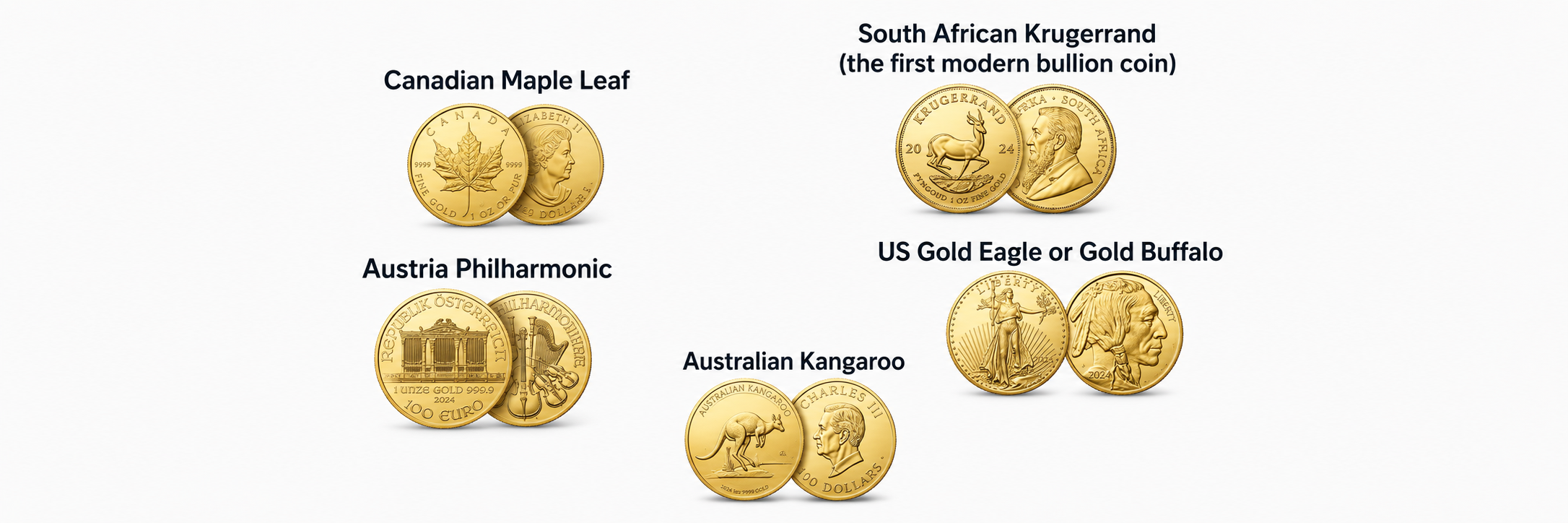
In most cases, choosing between these coins is simply a matter of personal preference. One is not necessarily better than another. Prices per coin or bar will vary slightly, but the differences are usually not significant. The US Gold Eagle is the most popular gold bullion coin.
Understanding Spot Price & Premiums
The Spot Price
The "spot" price is the price you see quoted in newspapers, on TV, or on dealer websites. It's the price used to trade contracts, options, and futures — the baseline reference for all precious metals pricing.
You will not typically be able to buy gold at the exact spot price. Spot is the foundation your cost is built on — not the final price.
The Premium
The premium is the amount you pay above the spot price for a coin or bar. It covers production, distribution, and dealer margin. Your "out the door" price equals spot price plus the premium.
The lower the premium, the lower your cost per ounce. Premiums can shift during volatile market conditions based on real supply and demand — they were higher than normal in 2023 due to strong private investor demand.
$15,000 in Silver
~40 lbs
Heavy, bulky, high shipping cost
$15,000 in Gold
Fits in your pocket
Compact, easy to store and ship
Typical Premium Examples
The following are representative premiums in a normal market. These can vary slightly week to week, but the differences between products are usually not dramatic:
| Product | Typical Premium Over Spot |
|---|---|
| 1 oz Gold Bars | Spot + $80–$100 |
| Krugerrands / Kangaroos | Spot + $100–$120 |
| Gold Eagles | Spot + $125–$150 |
⚠ Avoid Special & Limited Issue Coins
Dealers typically price special issue or limited mintage coins much higher per ounce — and you will rarely get that extra premium back when you sell. Salespeople love these coins because they earn a greater commission when the company makes a larger profit on your purchase.
Keep it simple. Stick to standard bullion coins and bars with transparent, market-based pricing.
What Are Normal Dealer Markups?
If you are dealing with a transparent dealer, standard markups on bullion should be modest — and clearly disclosed. Here's what to expect in a normal market:
Gold Markup
Above dealer cost (on top of Mint charges)
Silver Markup
Above dealer cost (higher due to production/shipping costs)
For example: the US Gold Eagle typically costs the dealer about 3.5% above spot (the Mint must make a small markup to produce the coin). The dealer then adds 3%–5% on top of that. Your total cost in a normal market is roughly 7%–9% over spot, depending on quantity.
Note: there are hundreds of sizes and types of gold and silver coins. You can buy as little as 1 gram of gold (31.1 grams per ounce). Popular sizes include 1/10, 1/4, and 1/2-ounce coins. Keep in mind: the smaller the coin, the larger the premium — it takes just as much effort for the Mint to produce a 1/10 oz coin as a 1 oz coin.
Watch Out for Hidden Fees
Some dealers advertise extremely low prices but then add a variety of fees — "handling fees," packaging charges, and other add-ons — that make the true price far higher than it appeared.
How to Choose a Trustworthy Dealer
Coin and bullion dealers are not regulated or licensed — which makes it essential to do your homework before trusting anyone with your money.
Industry Associations to Look For
Common Dealer Gimmicks to Avoid
There are always tactics some dealers use to separate you from your money. Here are the most common ones — and what's really going on:
"Free" Gold or Silver
There is no such thing as free gold or silver. When a dealer offers "bonus" silver if you spend a certain amount, the only way that's possible is if they've overcharged you enough to cover it. In one example, a client was offered $100,000 in product plus $10,000 of "free" silver from another dealer. Had they invested $100,000 with AmFed, they would have received nearly 20% more silver — even after accounting for the "free" silver from the competitor.
"1 of Only 500" — Buy Today or Miss Out
The urgency and scarcity claim is almost always a sham. Anyone can request special message labels from certification services. The coin is rarely as rare or exclusive as they claim, and the manufactured urgency is a high-pressure sales tactic designed to prevent you from doing proper research.
Below-Cost "Loss Leader" Coins
Some dealers advertise one coin at a below-cost price to get your attention — but to purchase it, you must also buy a variety of other coins at inflated prices. They more than compensate for the "loss" on one coin by overcharging for the rest.
The Rule of Thumb: Keep It Simple
The more a dealer pushes the purchase with "special" coins, limited quantities, or complicated explanations — the more likely you are being overcharged.
Getting a price should be remarkably simple: find out the spot price, understand the premium, and decide if it's right for you. If you don't understand what they're proposing — don't buy.
Locking In Your Price & Making Payment
Once you decide to buy or sell, here's how the process works at AmFed:
Price Lock
When you confirm or "lock in" a price, you are committed at that price regardless of what the metal does afterward. If gold goes down — you still own it at the price you confirmed. If gold goes up — you own it at the lower locked-in price.
The same applies when you are selling coins or bars to us. We immediately email a confirmation invoice for every purchase or sale. If you don't have email, we can mail, fax, or text it to you.
Payment Methods
AmFed accepts:
Personal checks · Bank wires · Cash · ACH
ACH is an electronic check — we use the routing and account number from your check to process it electronically, which speeds up the transaction.
Once payment clears, we ship your metals with a tracking number provided. Everything is 100% insured.
Why Clients Trust AmFed
American Federal (AmFed) has been in business in the Phoenix area since 1983. We belong to all the major industry organizations listed above, and our small team of just five brokers won't fast-talk or pressure you. We believe in giving you the information you need to make a decision you feel good about.
Nick Grovich is my choice for coins and precious metals. Nick knows a tremendous amount and he is honest. It takes a lot for me to personally endorse someone because it's my reputation at stake! With Nick, I do not hesitate to do so — I'm delighted to be associated with Nick Grovich.
Dennis Prager
Best-selling author and syndicated radio talk show host
I have worked with several precious metals dealers over the years and American Federal Rare Coin & Bullion is the only dealer that I personally trust with my precious metals portfolio. I am so happy with American Federal's expertise and the knowledge they share to enable me to make informed and educated decisions.
Michael Medved
The Michael Medved Show — America's #1 Show on Pop Culture and Politics
Nick Grovich is exactly what I want. Whatever you want, he will do it for you in precious metals. You want to sell your gold coin, he'll buy it from you. You want to buy bullion, he'll sell it to you. You want to buy an American Eagle for the grandkids and not pay an arm and a leg — he'll make his commission and tell you what it is.
Hugh Hewitt
The Hugh Hewitt Show
Ready to Buy Gold the Right Way?
Call us or request our free Special Report on dealer tactics — written by Nick Grovich — for even more detail on how to protect yourself and get the best price.
Call (800) 221-7694 Request the Special Report